Graduate Research Assistant at UTK
January 2022 - May 2026, Knoxville, TN
Summary: At UTK, I worked on computational mechanics for impact- and blast-relevant microstructured materials, with emphasis on resonant metamaterials, high-rate response, and simulation workflows that make large design studies feasible. My work focused on PDE solvers (FEM, DG, phase-field), constitutive modeling, and research-computing infrastructure.
Advisor: Prof. Reza Abedi
Project context: ARL-funded project Innovative Material Systems for Engaging Ballistic Energy, with Alireza V. Amirkhizi and Reza Abedi.
Key outcomes:
- Published paper on time-domain analysis of locally resonant elastic metamaterials under impact.
- Demonstrated ceramic metamaterial designs that slow wave propagation by 5x relative to conventional materials.
- Showed that graded metamaterials can reduce energy transfer by 6x versus uniform metamaterials, while material damping can amplify performance up to 4x versus monolithic slabs.
- Developed UMAT and postprocessing workflows for ceramic (Johnson-Holmquist 2) and clay material models, alongside broader simulation support for the group’s research workflows.
Contributions
1. Time-domain analysis of resonant metamaterials
I used time-domain finite element analysis to investigate how finite metamaterial slabs respond to impact and blast loading. The simulations compared uniform and graded designs and examined the effects of resonance, damping, and boundary conditions that infinite, frequency-domain models do not fully capture.
The designs slowed wave propagation by a factor of five relative to conventional materials. Grading reduced energy transfer by a factor of six relative to uniform metamaterials, and material damping amplified performance by up to a factor of four relative to monolithic slabs. This work was published in Mechanics of Advanced Materials and Structures.
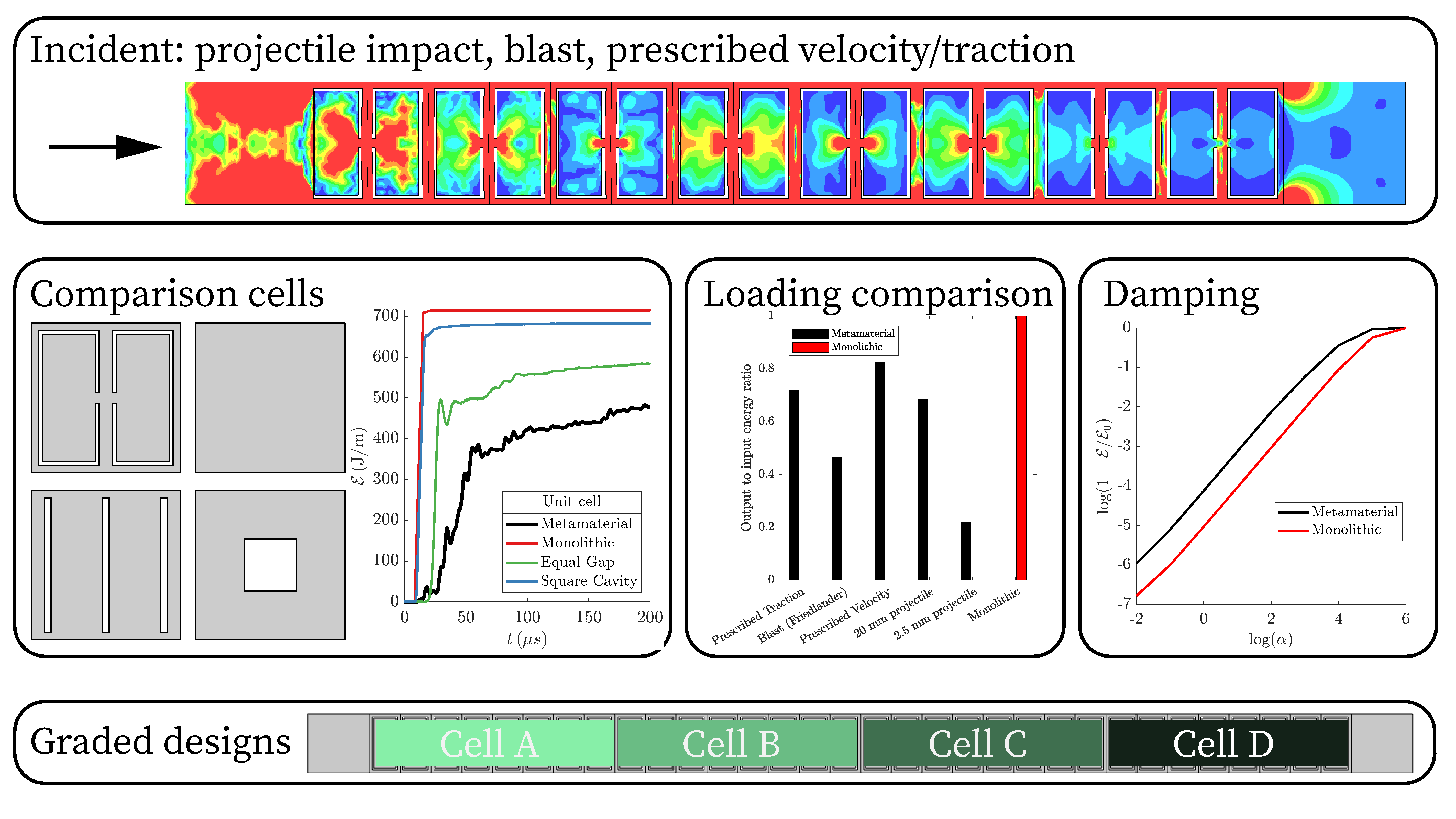
Graphical abstract (Caliskan et al., 2026, MAMS).
2. Nonlinear material modeling and simulations
- High-speed impact and blast simulations for ceramic materials and resonant microstructured media.
- UMAT development in LS-DYNA for ceramic and clay material models, including Johnson-Holmquist 2 based work for ceramics.
- Postprocessing and supporting workflows for nonlinear simulation studies.
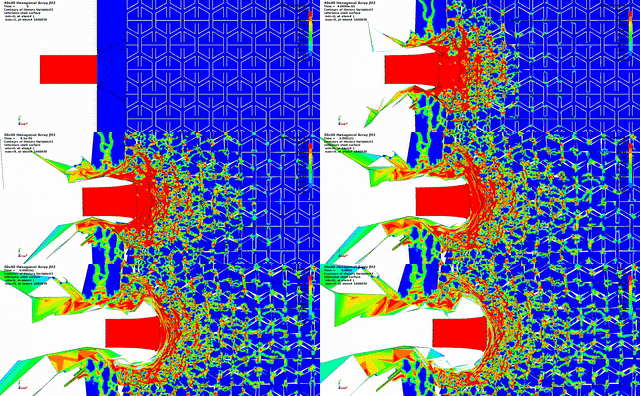

LS-DYNA simulations of hexagonal and square alumina (Al2O3) metamaterials under impact
with Johnson-Holmquist 2 material model.

Boron carbide (B4C)/silicon carbide (SiC) ceramic composite simulation.
3. Computational methods and research infrastructure
- Incorporated residual eigenstrain into an Abaqus UEL phase-field subroutine to account for thermal effects.
- Delivered arbitrary Lagrangian-Eulerian (ALE) simulations to investigate fluid-microstructure interaction.
- Studied 1D discontinuous Galerkin solvers in C++ and compared formulations for elastodynamics.
- Trained Ph.D. researchers on HPC workflows and maintained the lab computing environment through software compilation, benchmarking, and troubleshooting.
4. Dispersion and stability of DG formulations
With Reza Abedi, I compared continuous Galerkin and four discontinuous Galerkin formulations for one-dimensional elastodynamics in a common weighted-residual framework. The study examines how the interpolated fields and interface traces affect numerical dispersion, dissipation, and stability, including comparisons against exact transfer-matrix band structures for layered media.
Preprint: A unified dispersion and stability analysis of discontinuous Galerkin formulations for one-dimensional elastodynamics. Read PDF.
Selected Outputs
-
Heidari Shirazi, Ali, Erdem Caliskan, Alireza V. Amirkhizi, and Reza Abedi. “A Higher-Order-Mode Scattering Framework for Periodic Elastic Slabs.” Under review.
-
Caliskan, Erdem, and Reza Abedi. “A unified dispersion and stability analysis of discontinuous Galerkin formulations for one-dimensional elastodynamics.” (2026). Preprint. PDF
- Caliskan, Erdem, Willoughby Cheney, Weidi Wang, Thomas Plaisted, Alireza V. Amirkhizi, and Reza Abedi. “Time domain analysis of locally resonant elastic metamaterials under impact.” Mechanics of Advanced Materials and Structures 33, no. 1 (2026): 2619034. Publication link
- Abedi, Reza, Colin Furey, Farhad Pourkamali-Anaraki, Giang Huynh, Erdem Caliskan, and Alireza V. Amirkhizi. “Analyzing fragmentation response of heterogeneous ring using the method of characteristics and machine learning techniques.” Computer Methods in Applied Mechanics and Engineering 436 (2025): 117709. Publication link
- Cheney, Willoughby, Weidi Wang, Reza Abedi, Erdem Caliskan, and Alireza V. Amirkhizi. “Time Domain Parameter Extraction for High-Efficiency Reduced Order Models of Resonant Microstructured Media.” Manuscript in preparation.
Methods and tools: LS-DYNA UMAT, Abaqus UEL, time-domain finite element analysis, ALE simulations, C++, and Linux/HPC workflows.