Graduate Internship at ORNL
May 2024 - Dec 2024; May 2025 - May 2026, Oak Ridge, TN
Summary: At ORNL, I developed graph neural network surrogates for microstructure-sensitive material response, from elastic properties and stress-strain curves to fatigue-critical extremes. My latest work predicts the maximum fatigue indicator parameter (FIP) across an entire microstructural domain, extending graph-based prediction beyond average material response to the extreme values relevant to fatigue localization.
Mentor: Massimiliano Lupo Pasini, Computational Coupled Physics, Computational Sciences and Engineering Division (CSED), Computing and Computational Sciences Directorate (CCSD), Oak Ridge National Laboratory
Key outcomes:
- Developed GNNs that predict domain-level maximum FIPs, together with grain-scale distributions and peaks in a single hierarchical model.
- Evaluated four fatigue cases across five domain sizes, with calibrated uncertainty at both grain and domain levels.
- Derived an extreme-value bridge from grain statistics to domain maxima and investigated the limits of directly regressing an extreme value.
- Published multitask elastoplastic surrogates for dual-phase polycrystals and compact stiffness/strength surrogates for fiber composites.
- Contributed to HydraGNN code quality and scientific machine learning workflows on Linux/HPC systems.
Research Highlights
1. Predicting domain-level fatigue extremes
Objective: Predict the highest fatigue indicator parameter across a microstructural domain, rather than only an average response. These maxima describe fatigue-critical localization that a domain average can obscure.
Model: I developed a hierarchy-aware multitask GNN using crystal-plasticity finite-element data for austenitic stainless steel. A single graph model predicts within-grain FIP distributions, per-grain peaks, statistics of those peaks within a domain, and the domain-level maximum. The study spans Fatemi-Socie and plastic-work-based FIPs under high-cycle and low-cycle fatigue, across five statistical volume element (SVE) sizes.
Achievements:
- Built a dedicated graph-level prediction head for the maximum FIP over the entire domain, alongside grain-level outputs.
- Calibrated predictive uncertainty at grain and domain levels and examined aleatoric and epistemic contributions.
- Derived a closed-form extreme-value bridge using a Dirac-Gumbel mixture to connect grain-level statistics with domain maxima.
- Identified a key limitation of direct maximum regression: it captures domain-size scaling but misses variation among microstructures of the same size. Using measured grain statistics, the bridge recovers this variation; using predicted statistics, performance depends on the fatigue regime.
Preprint: Extreme-value-aware graph surrogates for fatigue localization in austenitic stainless steel. Manuscript in preparation for submission. Read PDF.
2. Multitask polycrystal surrogate modeling
I represented dual-phase ferrite-martensite polycrystals as grain-adjacency graphs, using phase, geometry, crystallographic orientation, and misorientation as features. The multitask model predicts 10 scalar elastoplastic quantities and full stress-strain curves across material compositions and SVE sizes.
The surrogate preserves population-level variability and supports statistically consistent random fields for mesoscale fatigue and damage analyses. Published in Journal of Materials Science: Materials Theory, 10, 8 (2026). Published article.
3. Fiber-composite surrogate modeling
I developed topology-based graph surrogates for the full stiffness tensor, peak strength, and brittle-fracture initiation strength of 2D fiber composites. Physics-based normalization stabilizes learning at extreme material contrasts, while Voronoi-derived features improve performance with small datasets.
The models predict stiffness with 160 times fewer parameters than CNN baselines and improve peak-strength prediction accuracy using 12 times fewer parameters. This work was published in Materials & Design, 257, 114500 (2025).
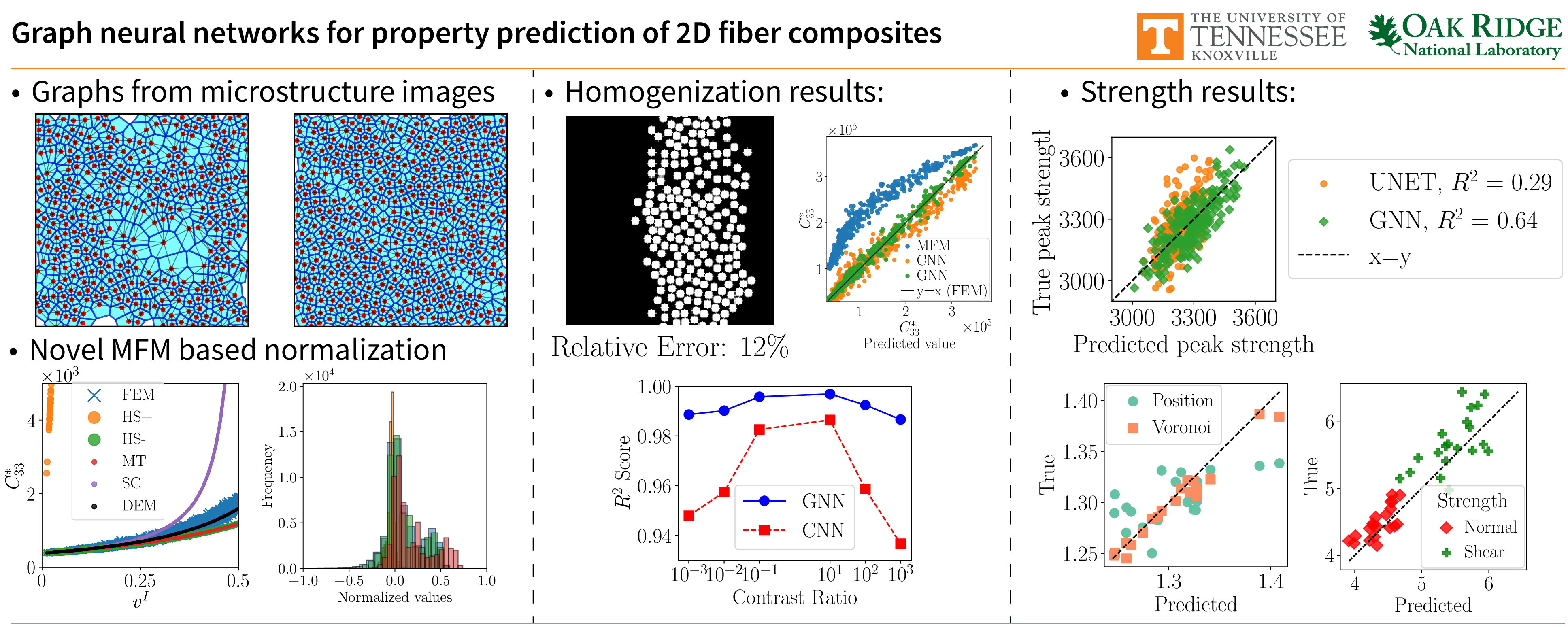
Graphical abstract (Caliskan et al., 2025, M&D).
Open Research Data
Coauthor, CP2D Dataset: Dual-Phase Polycrystal SVEs with Elastic and Plastic QoIs (2026).
The public dataset supports our work on dual-phase polycrystal surrogate modeling. The release includes microstructure graphs, tabular elastic and plastic quantities of interest, and a saved data split for reproducible studies. Dataset and citation on Zenodo.
Selected Outputs
- Caliskan, Erdem, Reza Abedi, and Massimiliano Lupo Pasini. “Graph Neural Networks for Mechanical Property Prediction of 2D Fiber Composites.” Materials & Design 257 (2025): 114500. Publication link
- Caliskan, Erdem, Anik Das Anto, Massimiliano Lupo Pasini, Stephanie TerMaath, and Reza Abedi. “Multitask graph neural networks for elastoplastic response prediction in dual-phase polycrystals.” Journal of Materials Science: Materials Theory, 10, 8 (2026). Published article
- Caliskan, Erdem, Anik Das Anto, Stephanie TerMaath, Reza Abedi, and Massimiliano Lupo Pasini. “Extreme-value-aware graph surrogates for fatigue localization in austenitic stainless steel.” (2026). Preprint; manuscript in preparation for submission. PDF
- Caliskan, Erdem, Anik Das Anto, Reza Abedi, and Massimiliano Lupo Pasini. “Probabilistic Multi-Task Graph Neural Network Surrogates for Elastic-Plastic Behavior and Fatigue Indicator Prediction in Polycrystalline Alloys.” In SES Conference 2025, Atlanta, Georgia, USA, October 12-15, 2025.
Methods and tools: HydraGNN, PyTorch, PyTorch Geometric, microstructure-derived graphs, grain-adjacency graphs, hierarchical multitask learning, extreme-value statistics, uncertainty quantification, physics-based normalization, Voronoi-derived features, and Linux/HPC workflows.